Start an AI feature with an observable task
Turn meeting notes into evidence-linked draft tasks, distinguishing active commitments, missing information, valid structure and reviewed creation.

Start an AI feature with a user decision you can observe. “Summarize our documents” leaves too much unspecified: who reads the result, what they need to decide and what an incorrect sentence could cause. A narrower task gives the model a useful role and gives the surrounding software something concrete to enforce.
My preference is to write the input, proposed output and permitted effect before choosing a model. For a developer moving from full-stack work into AI, this preserves familiar responsibilities: access checks, version identity, state transitions and understandable failure handling. The unfamiliar part is that a well-formed model response can still misread the source.
Replace a broad feature with one reader task
Consider a hypothetical meeting-notes product. Its user wants to turn explicit, still-active commitments in one note into draft tasks for review. The feature receives a saved document version the user is allowed to read. It proposes an action, the named owner, an explicitly stated due date if one exists, and source evidence. It does not assign work merely because someone mentioned a topic.
The scope is intentionally limited to written notes in the supported language. It does not transcribe audio, identify unnamed speakers, infer organizational responsibilities or resolve relative dates from missing context. Those could become separate features with their own evidence and failure handling. They are not hidden obligations inside the word “summarize.”
Here is the complete fictional input:
L1. Meeting note, 2026-09-18. L2. Maya: I will send the revised launch checklist by 2026-09-22. L3. Omar: Could we also translate the setup guide? L4. Decision: translation is deferred; no owner or date assigned. L5. Luis: I will verify the staging backup. L6. Maya: I withdraw my earlier checklist commitment; release scope changed.
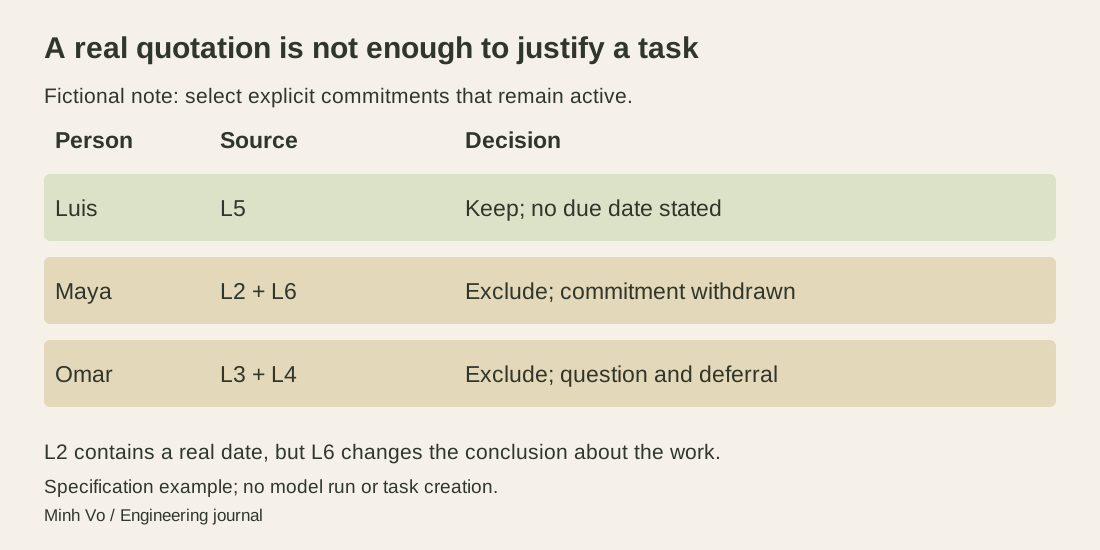
A proposed extraction contains one active commitment: Luis will verify the staging backup. Its due date is absent. The question about translation is not an assignment, and the later withdrawal means Maya’s earlier statement is no longer an active commitment in this document version.
A short, fluent summary might mention all three topics accurately while still being unsuitable for task creation. The product needs a specific selection rule, not simply a shorter paragraph. This distinction is where much of the engineering work begins.
Make absence and context part of the contract
Represent an unstated due date as an explicit absence, such as null. Do not fill it with the meeting date, the date from another person’s action or a plausible Friday. Likewise, a source that names no owner cannot justify inventing one from job titles or previous meetings that were never supplied.
The supported rule here is explicit commitment, named owner and no later cancellation in the same supplied note. In a less clear document, an unresolved contradiction should enter a review-needed state rather than being silently settled by the model. Deciding that a statement is ambiguous is different from claiming there are no commitments.
The candidate must point to the version it came from. Line identifiers are useful inside this small fixture, but “L5” alone is not a durable source identity: an edited document can put different text on that line. Attach the document identifier and version, and show the supporting passage from that version when the user reviews the candidate.
For Luis, the evidence is L5. For rejecting Maya’s candidate, the relevant context includes both L2 and L6. A real quotation is not automatically sufficient evidence for the proposed action. The surrounding text can change what the quotation permits you to conclude.
Distinguish structured output from a correct answer
OpenAI’s Structured Outputs guidance describes schema-constrained responses and separately warns that structured outputs can still contain mistakes. A field with the right type does not establish that its value follows from the document.
For example, an object naming Maya, a checklist task and the date 2026-09-22 could be perfectly well formed. It could even quote L2 exactly. It would still violate the active-commitment rule because L6 withdraws that work. A schema cannot replace the semantic decision the feature is supposed to make.
Keep two checks separate. The application can validate the response shape, required identifiers and whether a cited passage belongs to the supplied version. The proposed task also needs to satisfy the extraction rule in context. An exact substring check can establish that text occurs; it cannot establish that the text is a current assignment.
Handle unsuccessful model operations explicitly. A refusal, interrupted request or unusable result should not become a success with an empty task list. The user needs to know whether the feature found no qualifying commitments or failed to complete the analysis. The source remains available so the person can continue manually.
Compare with a useful baseline before adding automation
A workable first version can show the saved note beside a manual draft-task form. The user selects a passage, enters the owner and leaves the date blank when it is not supplied. That is a non-model baseline with the same review and creation boundary. It already tests whether turning notes into draft tasks helps the intended reader.
Martin Zinkevich’s Rules of Machine Learning recommends being willing to launch without machine learning and designing metrics early. The useful lesson here is to establish the product behavior and comparison first. The guide’s historical heuristic examples do not predict how much faster this particular LLM feature will be.
Compare the assisted path with the manual path on the same kind of notes. Observe whether reviewers find the correct active commitments, remove false candidates and preserve missing information. Record the effort of checking suggestions as well as entering a task. A suggestion that takes longer to verify than to write may not improve the workflow.
No user study or model run was performed for this article. The meeting note and proposed outcomes are a specification exercise. A real benefit claim needs observations from the intended task and users, not a model benchmark or an attractive screenshot.
Define outcomes before counting successes
A small outcome table prevents several different situations from collapsing into one empty response:
| Outcome | Meaning | Reader’s next step |
|---|---|---|
| Candidates ready | Completed analysis proposes reviewable commitments | Compare each candidate with its source |
| No qualifying commitments | Completed analysis found none under the stated rule | Continue reading or create a task manually |
| Review needed | Relevant statements cannot be resolved within scope | Inspect the conflicting passages |
| Unavailable | Analysis did not produce a usable result | Retry or continue manually |
These are proposed product states, not promises that a model will classify every document correctly. The application owns how it displays them and whether further actions are enabled. An empty candidate array is meaningful only alongside the status of the analysis that produced it.
OpenAI’s evaluation guidance recommends defining the task objective, dataset and success criteria, then including typical and difficult cases with human judgment. For this first boundary, preserve the fictional note as one explicit example and add independent examples before judging a model. One hand-written expected answer establishes a contract discussion, not a reliability estimate.
Keep false task suggestions separate from missed commitments when reviewing failures. Inventing an assignment and omitting a real assignment both matter, but they may create different work for the reader. A single satisfaction score can conceal which behavior needs attention.
Keep the model proposal separate from creating work
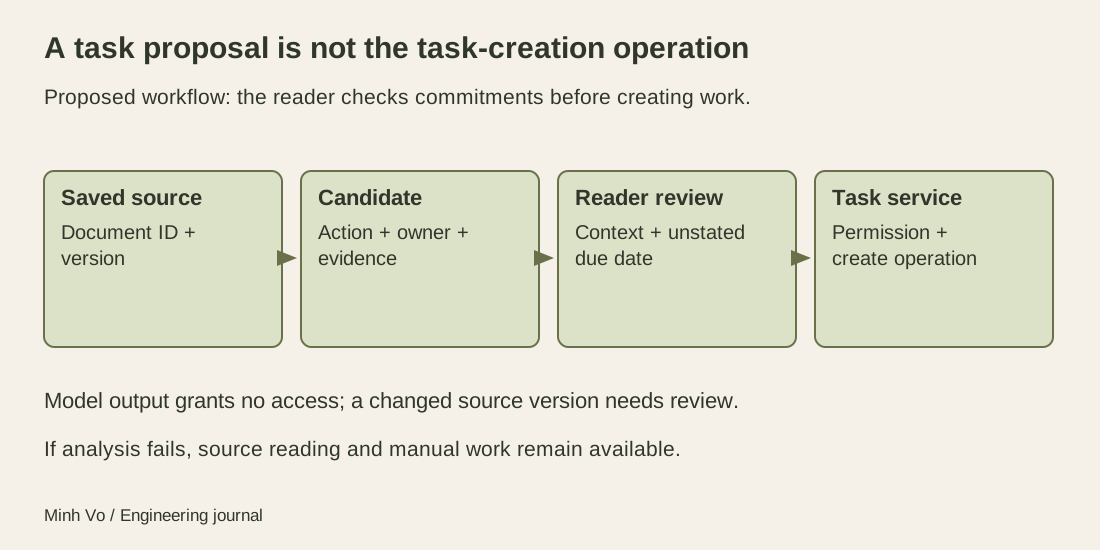
Reviewing a candidate is not the same operation as creating a task. The user may correct the wording, choose to leave it uncreated or discover that the source changed. If the document has changed since extraction, display the version mismatch and require the candidate to be checked against the current intended source before proceeding.
The existing task service still owns permission checks and task creation. Model output does not grant access or authorize an assignment. The create operation also needs ordinary application behavior for repeated clicks or an uncertain response, so the same accepted candidate does not casually produce duplicate tasks.
That surrounding work is a useful bridge from full-stack engineering into AI. The model supplies a proposal at one boundary; the product defines what the proposal means, how people verify it and when a durable action is allowed.
To complete the exercise, write the candidate for L5 with an absent due date and source-version identity. Then explain why L2 alone is insufficient, why L3 is not an assignment and what the interface should do when analysis fails. If those answers are unclear, refine the task before changing models. You will have a smaller feature that can be implemented, compared and challenged with concrete evidence.