Write a learning roadmap with stopping rules
Give a developer learning roadmap stopping rules, useful evidence and a deferred list that keeps curiosity from expanding every task.

A learning roadmap needs a way to finish its current step. For me, that finish should be an observable explanation or working behavior, with remaining questions kept in view. “Learn cloud” has no useful stopping rule. “Deploy a small service, identify its configuration source and recover from a deliberately failed release” is a bounded exercise.
This matters when your interests span several engineering domains. A new tool can always become another prerequisite if the plan has no explicit boundary. The result may be a long list of started courses with little evidence about what you can now do.
Replace subjects with answerable questions
Consider a hypothetical developer moving from frontend into backend and deployment work. Their initial list says: databases, Docker, cloud, observability and AI. Every item could occupy months. Rewrite the first stage around a small bookmark-saving service.
The questions might be: What happens when the same save request is repeated? Which component is allowed to read the stored bookmark? How can I tell that a deployed version is failing? Each question gives a reason to learn part of a broader subject.
The Google guidance on small changelists explains why smaller changes are easier to review and reason about. A learning step benefits from a similar boundary. You can inspect the whole result and identify the assumption that failed without also untangling several unrelated additions.
Define evidence and a stop condition
For each question, name an artifact and the condition that lets you move on. Avoid conditions that merely restate the activity, such as “finish the tutorial.” Finishing an activity may be useful, but it does not tell you what understanding remains afterward.
| Question | Artifact | First stopping rule |
|---|---|---|
| What does a repeated save do? | A request sequence and stored-state record | You can predict and verify the chosen duplicate behavior |
| Who can access a bookmark? | A permission table and request cases | The server enforces the stated ownership rule in the selected cases |
| How do I recognize a failed release? | A deployment and recovery note | Another person can follow the detection and recovery steps in the practice environment |
These stopping rules are intentionally local. They do not certify expertise in transactions, security or operations. They tell you when the present exercise has answered its question well enough to support the next one.
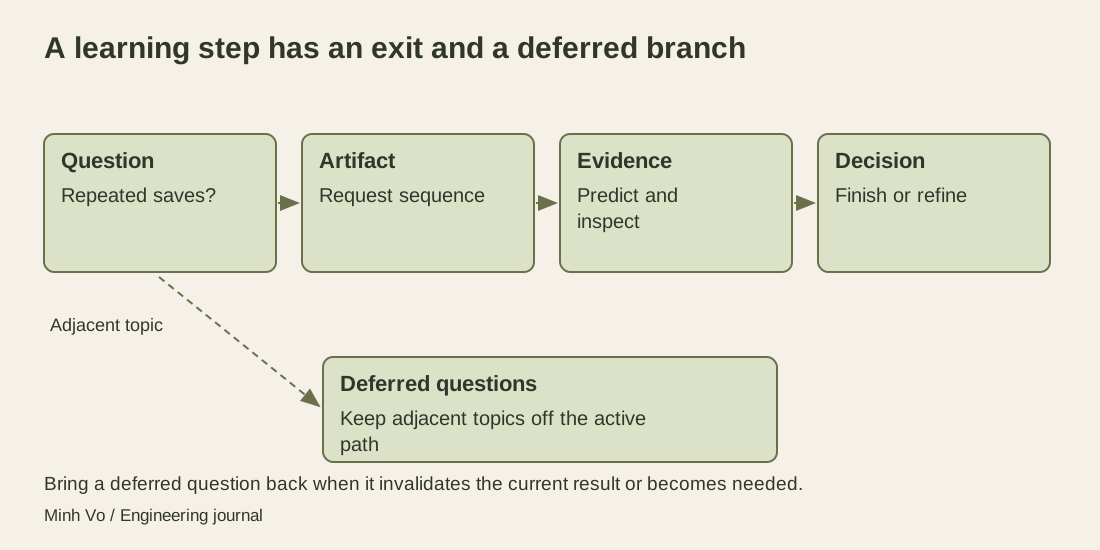
The deferred branch is part of the plan. If every new question stays on the active path, the stopping rule will keep moving. Write the question down, identify why it matters and decide whether it invalidates the present result or belongs to a later project.
Make room for a wrong prediction
A useful stop condition can include explanation after a failed attempt. Suppose you expected a repeated request to create one bookmark, but the application creates two bookmarks. The exercise has exposed a real misunderstanding. Fixing the behavior is only part of the work; explain why the original expectation did not match the operation’s contract.
The review by Dunlosky and colleagues discusses practice testing and distributed practice among learning techniques. In an engineering roadmap, return to an earlier question without the solution open. Predict the behavior, check it and explain any disagreement. The research does not supply a universal timetable for programming projects, so the schedule should remain adjustable.
A prediction that stays correct after a small variation is stronger evidence than recognition of the original answer. Change one input or failure point. If the explanation breaks, refine it before adding another tool.
Decide when to narrow the task
Sometimes the planned artifact is too large. Perhaps the deployment exercise depends on account setup, domain configuration and a database migration before you can study recovery. You have several choices: extend the project deliberately, replace the environment with a simpler one or split the question into separate stages.
Choose a smaller first recovery exercise when the extra setup contributes little to the intended lesson. For example, a local container can demonstrate how configuration reaches a process, while a later cloud exercise handles identity and network access. Keep those limits in the notes so local evidence does not become a claim about production readiness.
There is a tradeoff in every stopping rule. A strict boundary can hide useful connections if you refuse to revisit it. An endlessly flexible boundary can prevent completion. Treat a newly discovered risk as a reason to reconsider the scope, then make the change explicit.
Keep a record that helps the next session
End the current stage with the question, the evidence and the unresolved edge. A useful note might say: “Repeated saves now preserve one bookmark for the same operation identifier. I have not tested concurrent requests from separate devices.” That is specific enough to guide later work.
At the next planning session, choose between deepening that edge and moving to another dependency. The decision can reflect your actual project needs. A roadmap should help you use curiosity deliberately, including the decision to stop a successful exercise while there is still more to learn.
Make one stopping rule precise enough to fail
Take the repeated-save question and choose a concrete practice contract. A request contains an operation identifier and a bookmark URL. Repeating a completed request with the same identifier and the same URL should return the original bookmark. Reusing that identifier for a different URL should produce a conflict, because silently treating two different intentions as one operation would hide a caller mistake.
That is a proposed contract for this exercise, not the only possible bookmark design. A product might instead treat the URL itself as unique per account, allowing several independent save operations to refer to one bookmark. The distinction matters: duplicate operations and duplicate content are different questions. Decide which one the current step addresses before counting records.
| Case | Expected result under the practice contract | Evidence to retain |
|---|---|---|
| Save operation A with URL X | A new bookmark is created | Returned identifier and stored row |
| Repeat completed A with X | The original bookmark is returned | Same identifier and unchanged row count |
| Reuse A with URL Y | A conflict is reported | No silent replacement of X |
| Save operation B with X | Depends on the separate content-uniqueness rule | Explicit rule, rather than a guessed count |
The fourth row keeps the lesson honest. A test that expects a single row without stating whether URLs are unique can pass under one design and fail under another while neither implementation violates its own contract. A stopping rule needs a chosen behavior, not just a preferred number.
Decide whether a new question reopens the step
Now introduce two overlapping requests with operation A. Perhaps the current implementation handles completed retries but creates two rows when both attempts start together. If the stated exercise only covered a retry after completion, this is a newly discovered boundary. If the feature promised duplicate protection for all overlapping attempts, the result invalidates the stopping rule and the step must stay open.
Do not solve that ambiguity by quietly weakening the promise after seeing a failure. Record the original scope, the observed gap and the deliberate choice: extend the exercise to concurrency, or finish the narrower learning stage while preventing the prototype from being presented as ready for the broader use.
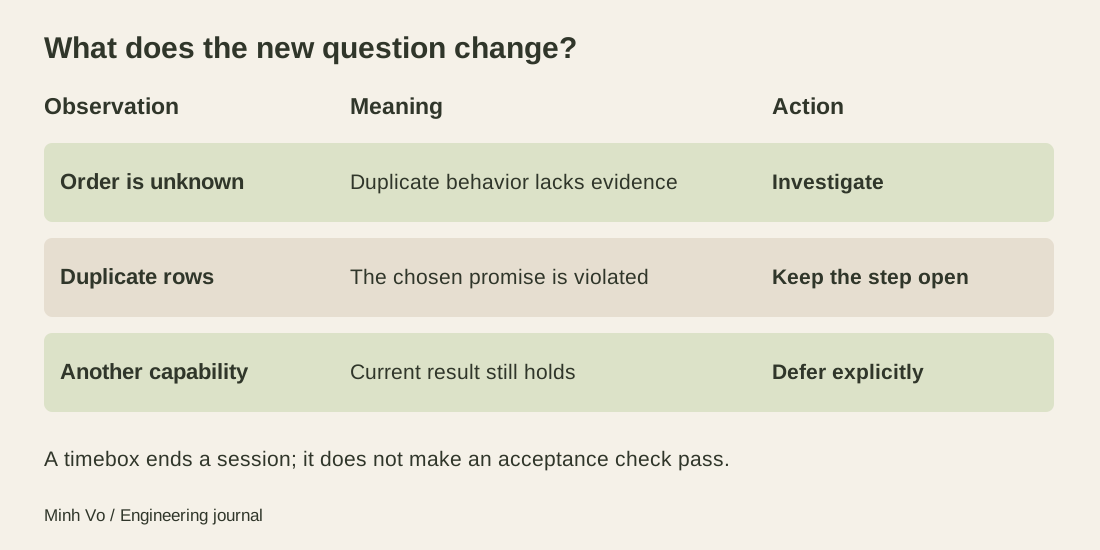
The decision flow helps when learning time is limited. A missing explanation calls for more investigation. A failure inside the chosen contract calls for a correction or an explicit scope change. A different product capability can move to the deferred list without erasing the evidence already obtained.
Use a time limit to choose an action, not declare success
A timebox can stop a session without proving the learning step complete. At the end of an evening, choose among three actions: preserve a passing result, reduce the next experiment to the uncertain boundary, or document a blocker that needs another source or environment. “Time expired” is a scheduling fact, not an acceptance result.
For example, if you cannot tell whether two requests overlapped, the next useful task may be adding a controllable pause or a request trace in the practice environment. Replacing the entire application framework is unlikely to answer that observation problem. A smaller experiment can expose the missing fact before you commit to a larger redesign.
Return to the step later with one changed input and the solution hidden. Explain which part of the contract should remain stable and which part needs a new rule. This gives distributed practice a concrete object: a question you can answer again, rather than a course page you can recognize.
The final artifact should let another developer distinguish what passed, what failed and what was deferred. That separation makes stopping useful. You have a reliable starting point for the next question, without turning a completed exercise into a claim that the entire subject is finished.