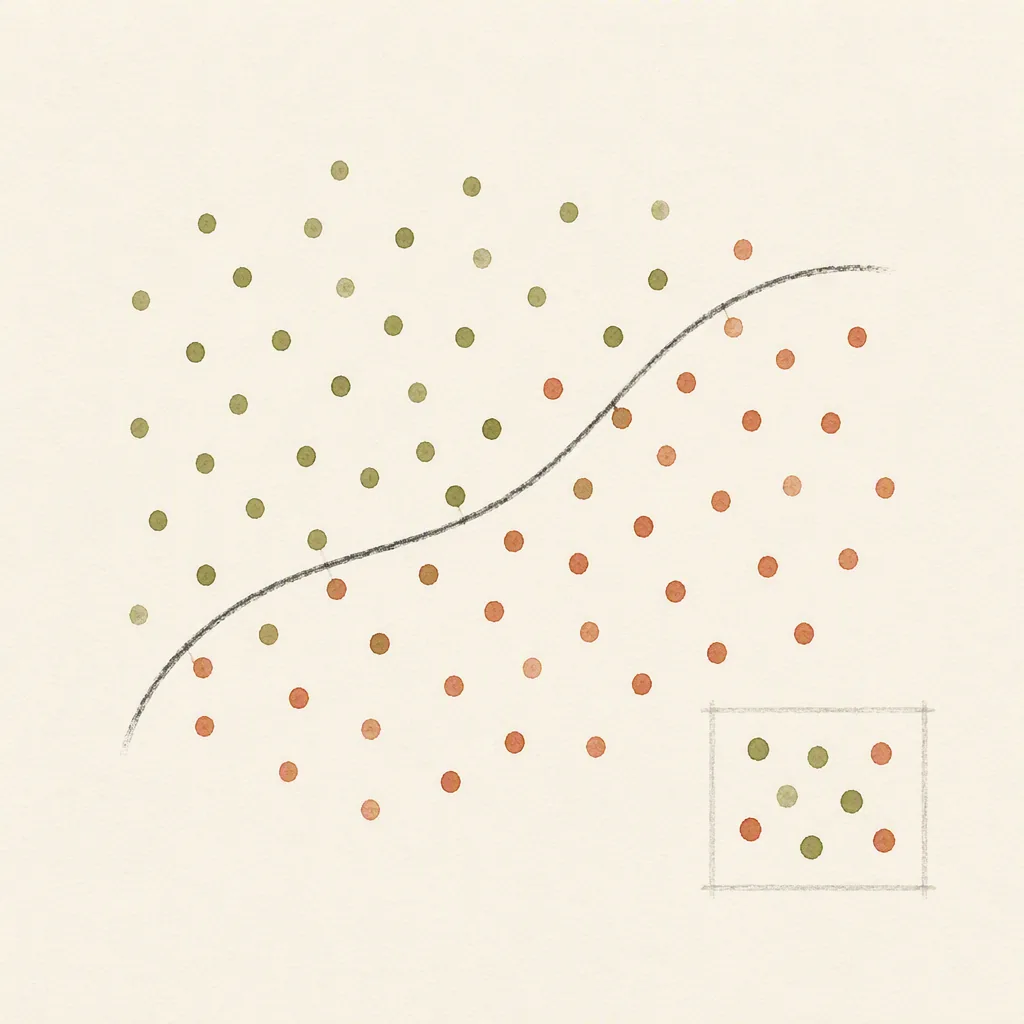
Likelihood is a function of the parameter
Derive a Bernoulli likelihood, compare sample-size effects and serial dependence, and reproduce why equal success counts need not mean equal sequence probabilities.
Foundation
The journal / Ideas in progress
Engineering & everyday learningSoftware, systems, and the things I’m learning along the way. From first principles to AI in production.
Find something to readA little theory. A lot of practice.
Derive a Bernoulli likelihood, compare sample-size effects and serial dependence, and reproduce why equal success counts need not mean equal sequence probabilities.

Calculate content, padding, borders and margins to diagnose an overflowing card, then distinguish box sizing from minimum sizes and transformed rectangles.

Give an agent explicit action, time, and cost limits, preserve enough budget for a useful handoff, and distinguish verified completion from exhausted effort.

Give a developer learning roadmap stopping rules, useful evidence and a deferred list that keeps curiosity from expanding every task.

Interleave a source read, commit, invalidation and late fill, then test how an atomic generation guard rejects obsolete cache writes.
Trace six independent instructions through a declared five-stage pipeline, calculate fill and drain overhead, and distinguish bubbles from global stalls.

Model a single FIFO help desk with explicit arrival ties, start times, waiting times, and idle periods, then separate service order from event scheduling.
Trace three-way quicksort partitioning on duplicate pivots, state its four-region invariant, and compare it with a two-way scheme that degenerates on equal input.
Preserve the focused control across theme changes, retain a pointer fallback, and verify clipping, viewport clearance and forced-color behavior.
Trace hits, recency changes and evictions in a three-entry Python cache, then check loader failures, cached None and a scan that misses every time.
Calculate expected loss, variance and the distribution of a two-case average, then test how copied observations and rare large failures change the evaluation.
A messy quantity column retains original tokens and rejection reasons. A worked analytical example with explicit assumptions and checked results.